
Leave your first name and email once, and all eight stories open on this phone. Scan once; no signing in again at every door.
Your info stays with Roche Home Co.
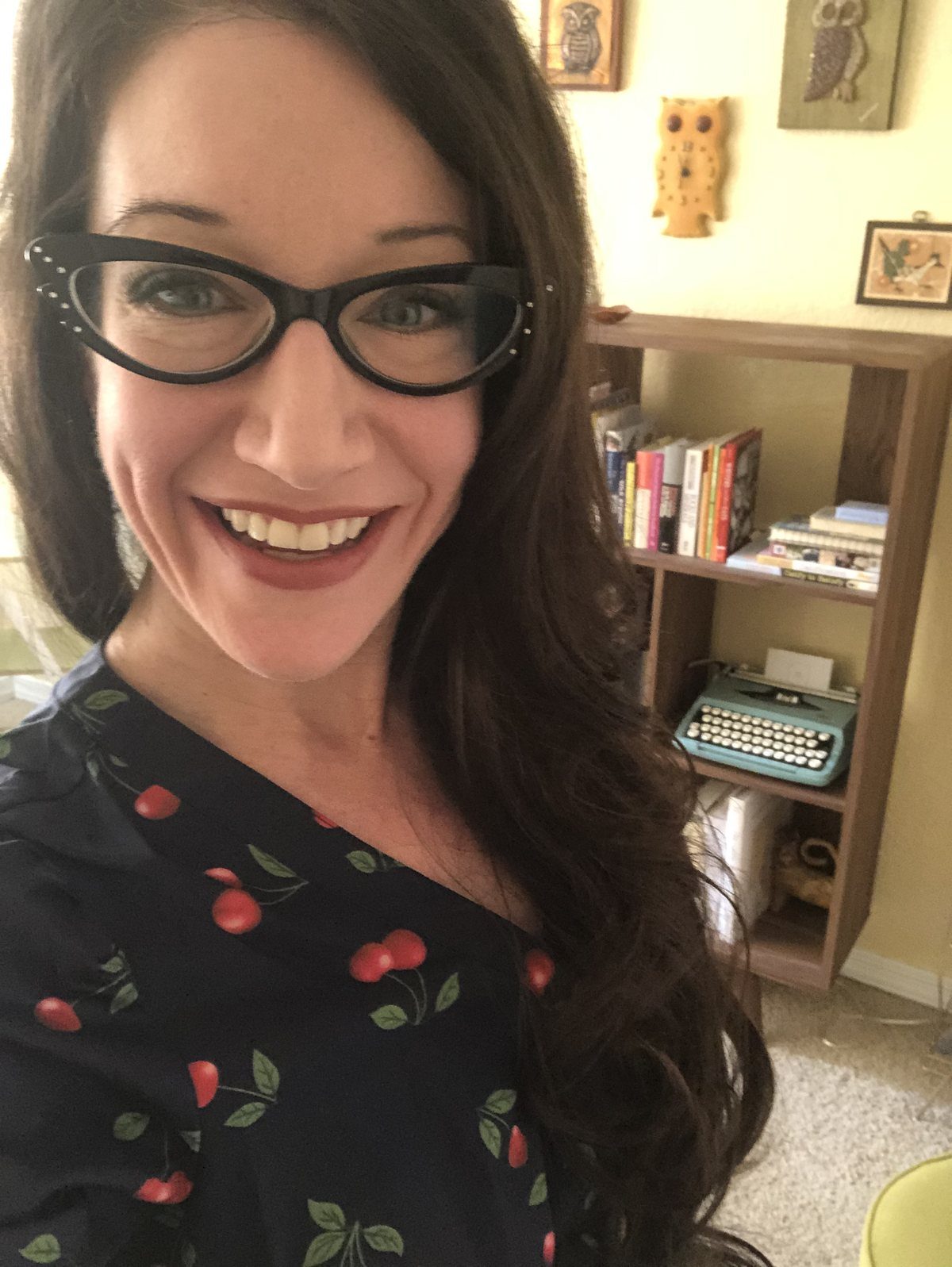
Writers gave this district its words: readings on patios during the art walk, small presses, zines passed hand to hand.
The Writer's Residence is named for all of them.
Of those writers, we recognize Rosemarie Dombrowski, Phoenix's first Poet Laureate, who started First Friday Poetry on Roosevelt Row and has spent years making sure other people get to tell their stories too.12
Long before Phoenix had a Poet Laureate, Rosemarie was already doing the job.
She has spent her career bringing poetry into the everyday life of this city. She taught it in classrooms. She carried it into community programs. And right here on Roosevelt Row, she created First Friday Poetry, giving writers and listeners a place to gather in the middle of the art walk crowds and hear what Phoenix sounds like when it slows down to speak.
In December 2016, the city made it official and named her Phoenix's inaugural Poet Laureate.1 It was an honor she had spent years earning.
Her work hasn't slowed since. She still teaches. She still reads in public. Through rinky dink press, she puts poems into small handmade books you can hold in one hand. Through Revisionary Arts, the nonprofit she founded in 2020, she uses poetry as a way for people to connect, reflect, and make room for voices that don't often get heard.6
She is also the author of four poetry collections, including The Book of Emergencies and Emily's Advice to Girls in the New Millennium.3
You might find her work in a classroom, at a reading, tucked into a tiny book, or somewhere in the middle of a community conversation. That range is the point. Rosemarie has never treated poetry as something that belongs only on a stage or a shelf.
In February 2018, Kimber Lanning offered Rosemarie the patio at Modified Arts for public literary programming. What began as a way to put the space to better use on art walk nights became First Friday Poetry on Roosevelt Row.2
The program put poetry directly alongside the murals, music and street activity people already came downtown for. The lineup changed every month: cultural storytelling, student work from ASU's Downtown Phoenix campus, female-identifying poets, writing from the Prison Education Program's Iron City Magazine, bilingual poetry with Cardboard House Press.2
There was also poetry on demand. You gave a poet a subject, and they wrote you an original poem on a typewriter, right there, and handed it to you.
“I'm a street poet. I was reared by street poets in downtown Phoenix.”2
Rosemarie Dombrowski
Kimber Lanning is honored two doors down, at The Steward's Residence.
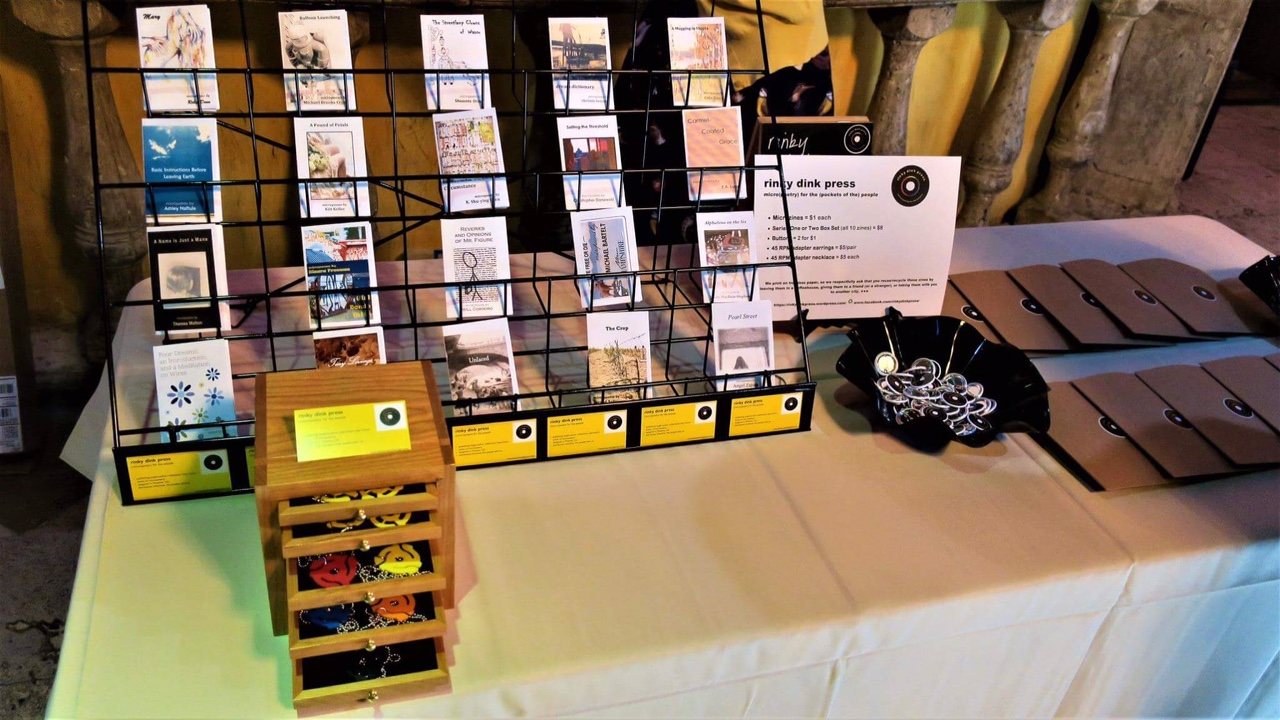
Rosemarie is the founding editor of rinky dink press, which publishes single-author poetry microzines: small, and deliberately cheap.
The press has published over 100 single-author micro-collections, each one priced at a dollar.5 The format is the argument. A poem that costs a dollar and fits in a pocket is a poem that can end up somewhere a hardcover never would.
Rosemarie is a medical humanist as well as a poet. She teaches at ASU and at the University of Arizona College of Medicine-Phoenix, and in 2020 she founded Revisionary Arts, a nonprofit running therapeutic poetry workshops for vulnerable populations and for the community at large.6
The work shows up as Verses for Vets, as ISSUED: stories of service, as the Grey Matter medical poetry journal, and as the Pharmacy of Poems.
At Banner-University Medical Center Phoenix, the Pharmacy of Poems offers curated poetic prescriptions built around experiences like hope, resilience, mindfulness and healing. A patient, a visitor or a member of staff can pick one up the way they'd pick up anything else at a pharmacy counter.
Your heart has been stored in a trunk,
in the vault of an old bank on Central,
tucked beneath a musty cushion
in the lobby of an iconic hotel.
Eventually, you grow to love the net in the sky,
the poems at the bus stop on the Melrose curve,
the sharply angled steel on 3rd St.
Everything is a revision of the previous story,
the smell of coffee and industry
colliding with centuries-old soil,
a city rising out of the intersection of cultures—
one ancient, the other an oasis
of steel and waterlines.
Uncrushed, your heart re-appears on a dumpster,
on the site of a once-empty lot
where you carved your name in the dust.
This is when you know you’ve mastered
the art of holding on,
and of letting go.
You are the roots of the neighborhood,
a pyramid of blossoms,
the candle of the Sonoran.
You are waxy leaves harboring water,
the oasis of the avenues,
your shrubs protecting the trees
from the sun, channeling its energy
into the spine, the heart of the fire,
how it burns for fifty years,
thousands of stories collecting
in its needles, waiting to bloom
like a species, a family,
a community in the desert.
Dive into the horizon.
Weave between concrete and sky.
Bury ourselves between
saguaro spines and wing bones,
layers of granite, sandstone, and ash.
Offer blessings to the ridges
that will swallow us like geologic time.
Honor everything that will outlive us—
the vision of the desert at dusk,
the light of our human resilience.
Shared by Rosemarie Dombrowski for Storied: The Roosevelt Chapter and reproduced with her permission. Please don't reprint them without hers.
Five-time Pushcart Prize nominee.3 Read about The Philosophy of Unclean Things, or see all of her publications.
When you support local artists, you are supporting your neighbors and your neighborhood.
A Storied Series by Bri Roche, founder of Roche Home Co.