Leave your first name and email once, and all eight stories open on this phone. Scan once; no signing in again at every door.
Your info stays with Roche Home Co.
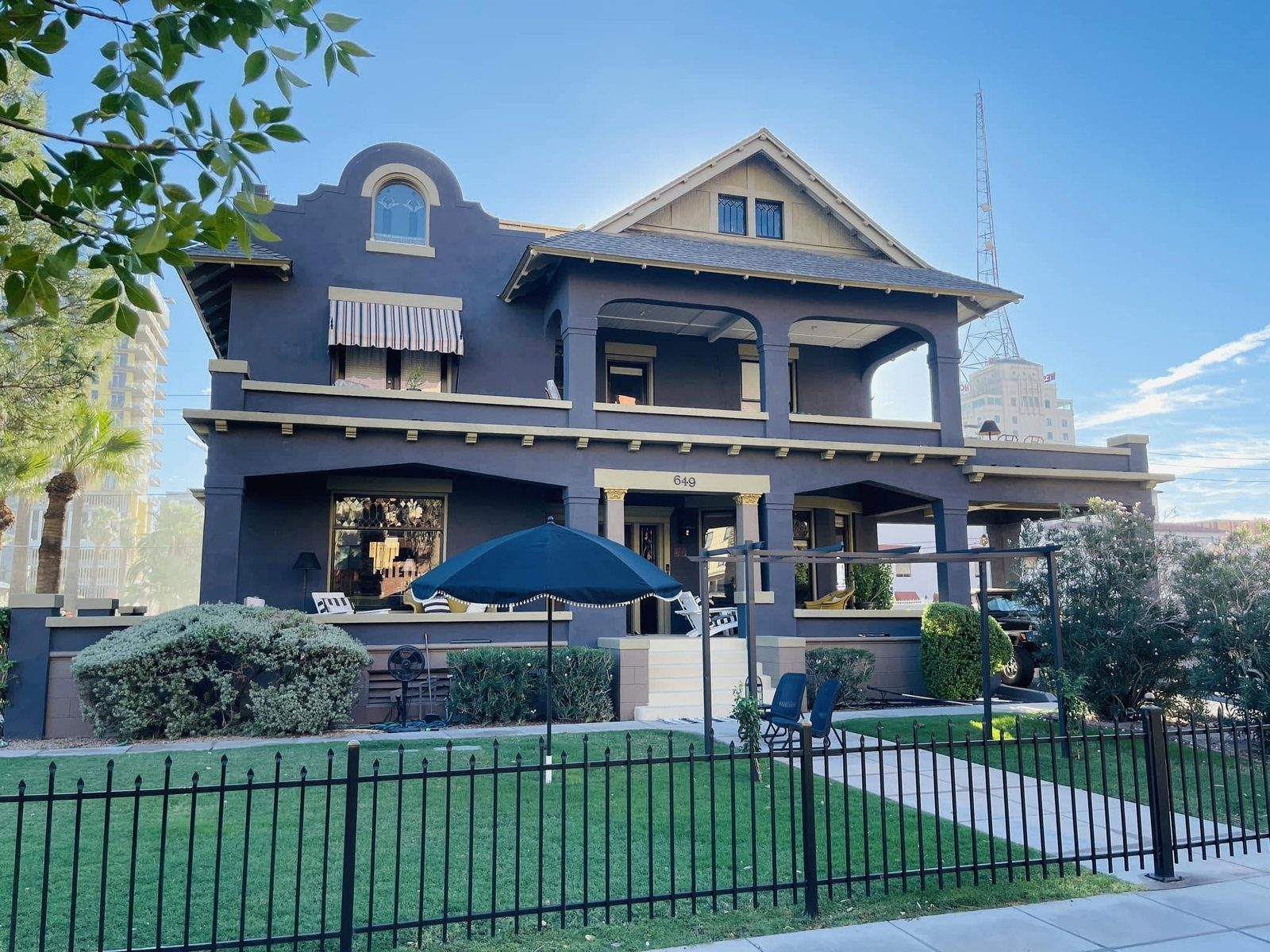
That is what the house has been called, and it fits. Mission Revival, Tudor Revival and Queen Anne all at once, with a metal pagoda-style cap on the roof. In its owners' words, the mix was meant to suggest people who had seen the world.1
Its story belongs to the community, and to the family who brought it back: Ken Kulas and Scott Underwood.
Before Roosevelt was an arts district, before Arizona was a state, the DeMund family was helping build Phoenix.
Herman P. DeMund came to Phoenix from Missouri in 1895. He and his brother established the DeMund Lumber Company and Phoenix Flour Mills, and the lumber business grew into one of the largest in the Southwest. He went on to found Arizona Hardware Supply and Southwestern Sash and Door, and served as investor and president of Valley Realty and Trust and Citizens' State Bank.1
He was also a celebrated trapshooter, and belonged to the Chamber of Commerce, the Arizona Club, the Knights of Pythias and the Independent Order of Odd Fellows. He organized the DeMund Lumber Company baseball team during Phoenix's earliest baseball era.1
Sarah Jane DeMund was born in England, the youngest of nine children. She married H.P. at nineteen, raised seven children in the house, became a charter member of the Phoenix Woman's Club, and lived there until her death in 1936.1
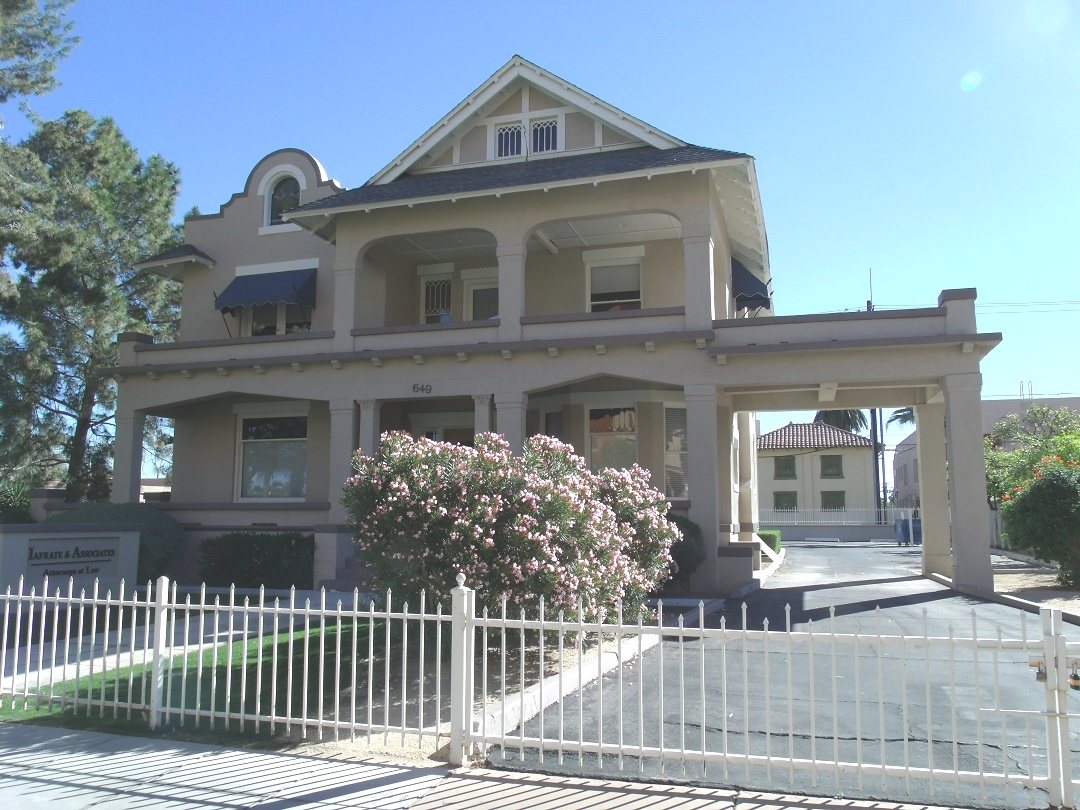
In 1907, years before Arizona was granted statehood, Mr. H.P. (Herman Percy) DeMund built this incredible mansion. Styled as “eclectic Victorian,” the fashion at the time was to include architectural features similar to Mission Revival, Tudor Revival and Queen Anne that suggested the owners to be well traveled. The roof of the home is capped with a metal, Asian-inspired pagoda.
H.P.’s fascinating history includes the DeMund lumber yard, the DeMund 9’s baseball team, his world record in skeet shooting, and many philanthropic downtown projects. Mr. DeMund and his wife, Sarah Jane, constructed the first Women’s Social Club, still visible from the mansion’s back porch at the northwest corner of McKinley and 1st Avenue.
Over the years the building served many functions, including most recently an attorney’s office. Ken Kulas and Scott Underwood purchased the mansion five years ago and began the transformation. The property at the time included seven offices, a break room (microwave and refrigerator only), a men’s room, a women’s room, and a thirty-car parking lot in the back.
Today, although still evolving, an expansive kitchen, three bedrooms with en-suite bathrooms, and a piano room, theater and wine cellar in the basement have been constructed. Ken and Scott have built and remodeled many homes, and the intent for this building was to revise the floor plan to reflect what might have been closer to the original layout, maintaining much of the millwork and wood flooring from 1907. The parking lot is now a grand swimming pool with three separate cabanas.
You will also find the resident “candy bars”: our Great Pyrenees, Oh Henry, Baby Ruth and Kit Kat.
Ken, with his background in hospitality design, imagines the mansion to have so many more opportunities yet to evolve. Future plans might include a period-styled, free-standing casita constructed over a three-car garage, an elaborate “speakeasy” type bar, and a small dance ballroom on the third floor. (If you look closely at the attic level, note that each side of the facade has unique stained-glass windows that allow light into a twelve-foot-high space. The ample-sized room has the original wood flooring as the main parlor.)
Please come and enjoy the home. If you share the history of the original DeMund family and their efforts to build early downtown Phoenix, it will undoubtedly be appreciated by future generations and help the Roosevelt Historic District thrive!
Written for Storied by the DeMund's owners. Shared as they wrote it, with light edits for spelling and punctuation, and with one historical claim about the baseball team removed because we could not confirm it. More on the team below.
This house was never sitting on its own. The DeMunds lived on Second Avenue inside a small, tightly connected world of early Phoenix families, and you can see it in other people's photo albums.
The clearest example is the Luhrs family. George H. N. Luhrs reached the Arizona Territory in 1869, settled in Phoenix for good in 1878, and his name ended up on some of downtown's landmarks: the Hotel Luhrs, the Luhrs Building and the Luhrs Tower.3
Arizona State University's Luhrs Family Photographs collection names the DeMunds among the family's friends. Its catalog finds the two families together again and again: on the road across the top of Roosevelt Dam, out in the desert, hiking Echo Canyon on Camelback Mountain.3
Not a business arrangement. Weekends.
The families may have overlapped at work too. The DeMund's own history says H. P. was president of Citizens' State Bank, and our research found period banking directories listing George H. N. Luhrs on that bank's board as well. We are still confirming that part.1
We haven't reproduced these photographs. ASU says it does not own their copyright and that permission has to come from the rights holder, so each card opens the photograph in ASU's archive instead. The captions follow the archive's own titles.
H. P. DeMund organized a baseball team through the DeMund Lumber Company.1 The Phoenix papers called it the DeMund team, or just the DeMunds. Its owners today call it the DeMund Nine.
It was an early Phoenix company-sponsored team, the kind of club local businesses fielded while baseball was taking root in territorial Arizona. You may read elsewhere that it was Arizona's first team, or its first professional one. We haven't found evidence for either, so we aren't saying it.
On a Sunday in September 1900, the Tempe Crimson Rims came to Phoenix to play them. The Arizona Republican's report the next morning was not kind to Tempe. The DeMunds won 10 to 2, their pitcher, Collins, gave up two hits, and the paper said that at no stage were the Tempe men given any hope.4
The same report says the DeMunds were lining up a series against the Indian School team and then a team from Los Angeles.4
The Crimson Rims deserve a story of their own. The team took its name from a brand of bicycle wheel, was probably organized by E. P. Carr, who ran a Tempe bicycle shop and later founded Carr's Mortuary, and is remembered for a roster of players of African, European and Mexican ancestry, rare for its time.5
…the Tempe Crimson Rims came to Phoenix Sunday with the avowed intention of figuratively wiping up the earth, at the ball park, with the DeMund team.
A small but enthusiastic crowd saw the Crimson Rims defeated by a score of 10-2.
Collins, the DeMund pitcher, was invincible, only allowing two safe hits to be made from his delivery.
We haven't found a photograph of the DeMund team. If you have one, we would love to see it.
The house refuses to sit in a single style. Its own history describes a facade blending Mission Revival, Tudor Revival and Queen Anne, with an unusual pagoda-like cap at the roofline and classical detailing including Greek acanthus-leaf columns.1
Inside are oak paneling, hand-carved floral woodwork, stone fireplaces and thick double-brick walls.1
The City of Phoenix designated the Herman P. DeMund House a historic property in September 1986, and it appears in federal records as part of the Roosevelt Neighborhood Multiple Resource Area on the National Register of Historic Places.26
The lumber yard was the start. According to the DeMund's own history, H. P. went on to found Arizona Hardware Supply and Southwestern Sash and Door, and served as president of Valley Realty and Trust and of Citizens' State Bank.1
He may have been in publishing too. Our research points to a 1913 ownership statement for Arizona: The New State Magazine listing H. P. DeMund as business manager and as one of the owners of the State Publishing Company. The scans are public domain, so you can check them yourself. We are doing the same.
Period documents, all digitized by the State of Arizona Research Library and marked No Copyright, United States.
Storied is not only about the people who made art here. It is about the buildings that survived long enough to tell us what Phoenix looked like before any of us arrived.
The DeMund has watched downtown go from a territorial town to the neighborhood outside its front door. It sits kitty corner from Residences on 2nd, close enough to walk to without thinking about it, and on October 2 its owners opened it for the night. That is the rarest thing on the whole walk, and an added bonus that felt wrong not to share.
On Storied night, this was the seventh stamp on the library card. Today it is a private home again, so please enjoy it from the sidewalk.
“Please come and enjoy the home.”
Ken Kulas and Scott Underwood, owners of the DeMund
Historic houses survive when people use them. Ken and Scott rent the pool and host events, which is part of how a 1907 house earns its keep.
A Storied Series by Bri Roche, founder of Roche Home Co.