
Leave your first name and email once, and all eight stories open on this phone. Scan once; no signing in again at every door.
Your info stays with Roche Home Co.
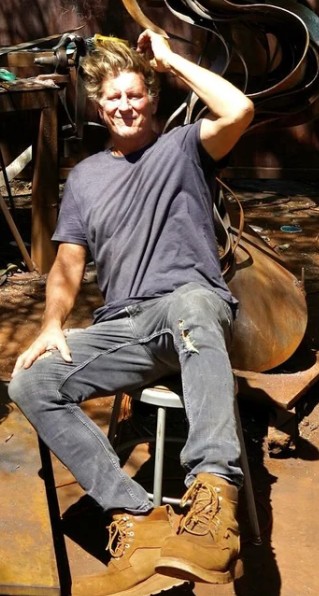
Sculpture is how a neighborhood gets landmarks you can walk around: steel in a front yard, a gateway on a corner, the piece you give directions by.
The Sculptor's Residence is named for the sculptors and metalworkers who gave Roosevelt and the neighborhoods around it a third dimension.
Of those sculptors, we recognize Peter Deise, because his steel is already part of the street: Whitewater in front of The Oscar, the polished metal flame at Seventh and Roosevelt, and a shipping container cut open with a plasma torch at First and Garfield.345
Before Roosevelt Row became the arts district most people recognize today, Peter Deise was already part of the artist community taking shape here.
Peter lived in Roosevelt in the early 1990s, during a formative period for the neighborhood's creative community. Over the decades that followed, his work became physically woven into Phoenix itself, from sculptures in historic front yards to large-scale public installations on Roosevelt Row.
His medium is often steel, but his inspiration comes from things that feel much softer: ocean waves, seed pods, leaves, microscopic structures, movement and growth.
That tension is what makes his work unmistakably his.
Peter was born near the sea and raised by a biologist mother and an electrical-engineer father. His mother introduced him to the microscope at the age of three, and his work still carries both influences: the curiosity of someone studying the natural world and the instinct of someone who wants to understand how things are built.1
He bends, heats, cuts, twists and ties steel by hand, sometimes on an enormous architectural scale and sometimes with an almost improbable delicacy.1
Peter's connection to Downtown Phoenix is not a recent one.
He lived in Roosevelt in the early 1990s and was part of the artist world forming here during a period when Downtown's creative identity was still being built person by person, studio by studio and gathering by gathering.
That history matters to us. The story of Roosevelt Row is not simply a story about murals or galleries that appeared one day. It grew from artists who lived here, worked here, opened their doors, collaborated and helped make creativity part of the identity of the neighborhood.
Peter has kept that relationship with Phoenix's arts community ever since, showing with Artlink over the years and, most recently, in its 2026 presentation with FOUND:RE Contemporary.49
Peter's early-1990s Roosevelt residency comes from Roche Home Co. project research rather than a published source.
In 2002, homeowners in the nearby F.Q. Story Historic District began receiving mysterious letters.2
An anonymous donor had purchased a group of Peter's sculptures and wanted to give them away. There were only two rules. The artwork had to remain visible from the street. And it had to stay with the house for at least a year.2
About a dozen Peter Deise sculptures were ultimately placed at neighborhood homes. The donor was fellow metal artist and F.Q. Story resident John Peirce, who asked to stay anonymous during his lifetime and who wanted to encourage a stronger arts culture Downtown.2
Many of the works stayed long after the one-year requirement ran out. Peter later called them the seed of everything that followed, the beginning of series built around pods, growth and curling tendrils. His own favorite is Chorisia, a reclining seed pod form.2
Now one more Phoenix home honors his work.
Peter's work begins with observation. His biography traces his fascination with nature back to that childhood microscope, and those same patterns turn up again in steel.1
A broad curve can echo the movement of an ocean wave. An intricate web of heated and hand-tied metal can resemble the veins of a leaf. A rigid material can suddenly appear to grow, curl or move.1
He works comfortably at both extremes, making forms massive enough to hold their own against architecture and details fine enough to need a much more patient hand.
His Crystalline Geometry series pushes that further. The Scottsdale Public Art commission for The Goldwater describes a piece that hovers partly over a pedestrian corridor, drawing on new neural connections in a healing brain, fractal patterns and the geometry of crystals. Shadows lengthen and conceal across the day, so the sunlight becomes part of the sculpture.6
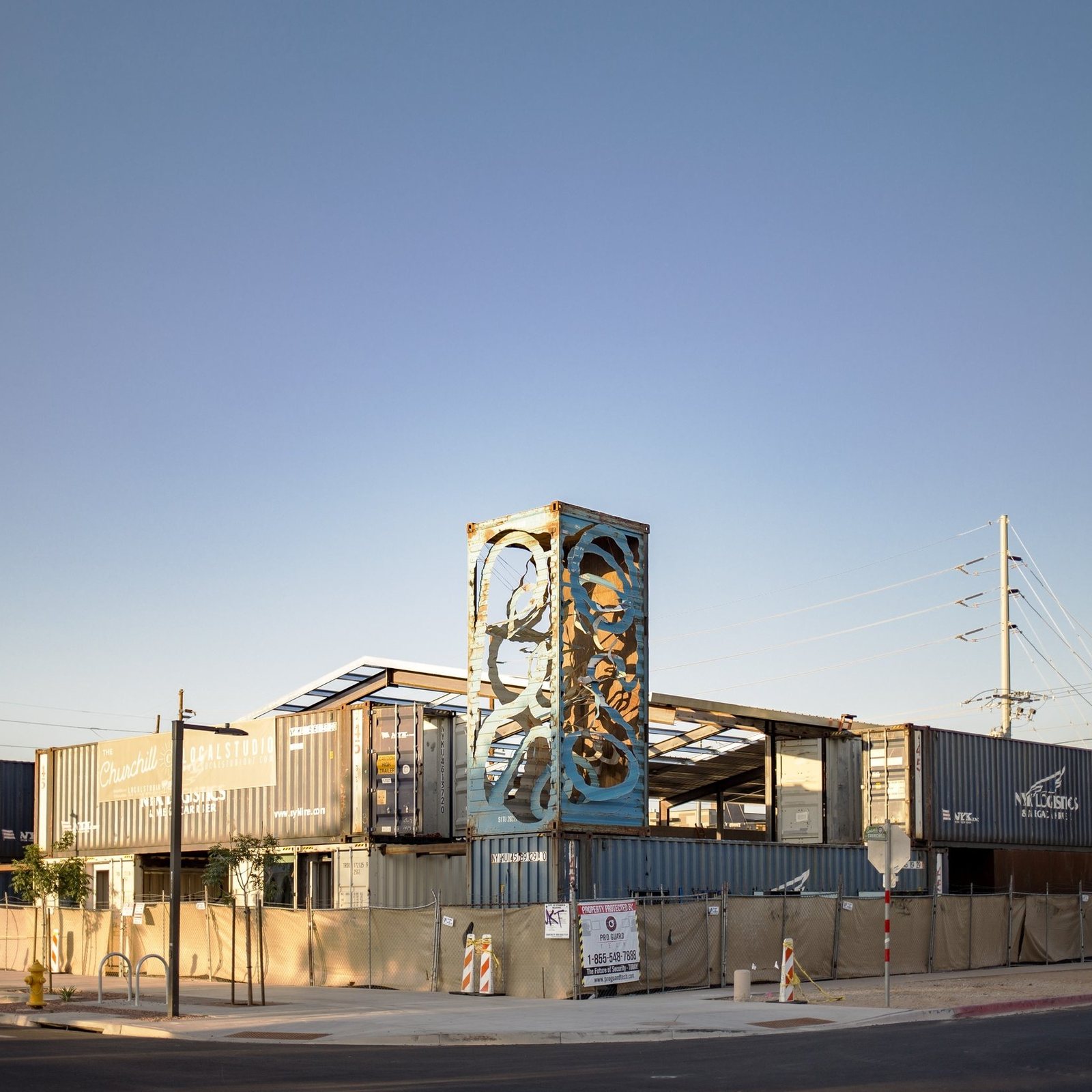
One of Peter's most visible works sits only blocks from The Sculptor's Residence, at First Street and Garfield.
He took a decommissioned shipping container, set a twenty-foot container vertically on top of a horizontal one for height, and cut into the steel walls with a plasma torch, leaving the cut pieces attached so they twist outward from the body of the container.3
The piece is called When Our Worlds Collide. Peter has explained the title as referring both to collisions at an atomic scale and to what he was watching happen around Roosevelt Row, a neighborhood where older and newer worlds were increasingly meeting one another.3
Instead of installing a sculpture onto the development, he turned part of the development into the sculpture.
The Sculptor's Residence is that too. Peter's work is a reminder that the interesting question is not whether places change. It is how the new enters into conversation with what was already here.
Peter's presence in the neighborhood is not limited to one piece.
Whitewater, a large-scale work made with metal and fire, stands in front of The Oscar on Roosevelt Row, and Phoenix New Times named it among the notable art in Metro Phoenix in April 2017.4
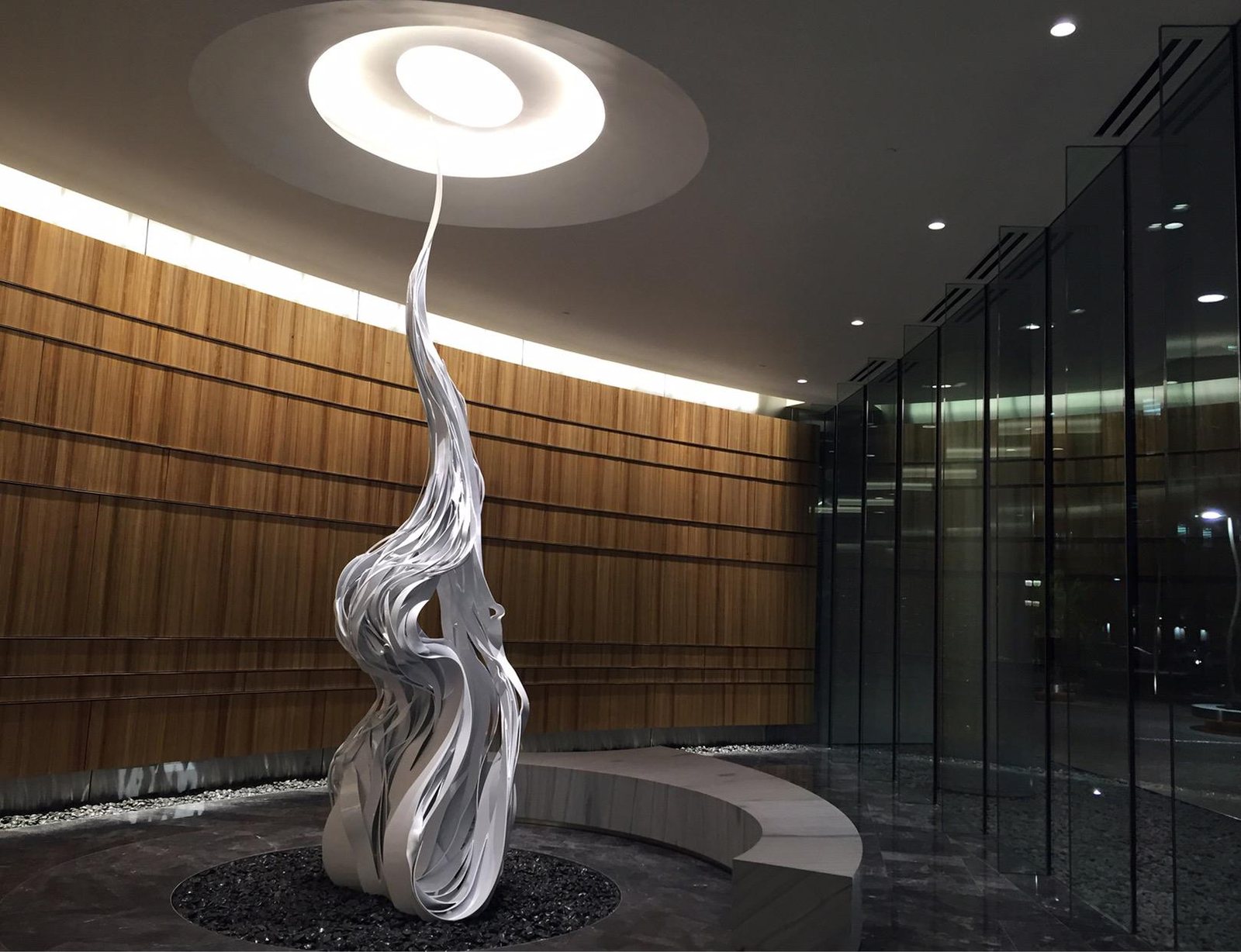
At the southwest corner of Seventh and Roosevelt, a polished metal flame by Peter became the centerpiece of the APS substation project, the piece Downtown Phoenix calls a front door to Roosevelt Row. It came out of four years of community process. The original proposal was a clocktower, until a resident objected that keeping time felt oppressive, and the team went looking for something that spoke to a neighborhood of artists instead.5
Peter's work increasingly occupies the space where sculpture and architecture meet.
In October 2024, Desert Design Week put his sculpture inside a modern Phoenix residence for an evening at Stay Skyeview in Arcadia. It sold out. The program described more than twenty years of Peter studying the relationship between art and nature through sculpture, painting, drawing and writing.7
That relationship between art and the home is also the subject of a conversation with Peter on Modern Home Mastermind, where he talks through his process, how the work has changed and what sculpture can do inside modern architecture and interior design.8
A conversation with artist Pete Deise, on Modern Home Mastermind with beSpoke brokers.
Peter's story is not finished.
In 2026, Artlink and FOUND:RE Contemporary included him in their invitational booth at Scottsdale Ferrari Art Week, marking FOUND:RE Phoenix's tenth anniversary and a decade of work with artists across the city.9
His work continues to appear in public projects, private collections, architectural spaces and exhibitions throughout the region.
That ongoing practice matters to this project. These residences are not memorials. They honor people who are still creating, questioning and contributing to the place around them.
We could have called it Unit 5.
Instead we named it for an artist whose work has been part of Downtown Phoenix for decades. Peter Deise lived in Roosevelt before it became the Roosevelt Row most people know. His sculptures later turned up in its public spaces, its architecture and the historic neighborhoods around it.
And through all of it, he kept returning to the same unlikely material. Steel. Something hard enough to build a city from, shaped until it looks almost alive.
When you support local artists, you are supporting your neighbors and your neighborhood.
A Storied Series by Bri Roche, founder of Roche Home Co.